
Higher Education / Admissions
Qualification Check helps admissions teams verify international qualifications, English language results and applicant identity directly with trusted sources so that you can catch fraud earlier, clear genuine applicants faster and be compliant.


The admissions reality
Your risk
Documents we screen flag a discrepancy
From altered grade classifications to qualifications that were never awarded. Most pass a visual check, which is exactly why they reach offer stage. Fraud has become more difficult to spot as technology has advanced.
Qualification Check Data Cube platform data
Your intake
Fall in new international student visas in the UK
Policy changes have made international recruitment less predictable. Institutions are competing harder for a smaller confirmed intake, making every applicant decision more consequential, not less.
Sector context · Home Office immigration statistics, year ending June 2026
Your team
Of HE professional services roles lost to restructuring since 2023
Admissions, Registry and Student Services teams across the sector have borne significant cuts as institutions respond to financial pressure. The work hasn’t reduced but the headcount has.
Sector context · UCEA / Universities UK
challenge
Fake or inconsistent qualifications pre-CAS, putting intake quality and your institution’s reputation at risk.
How we help
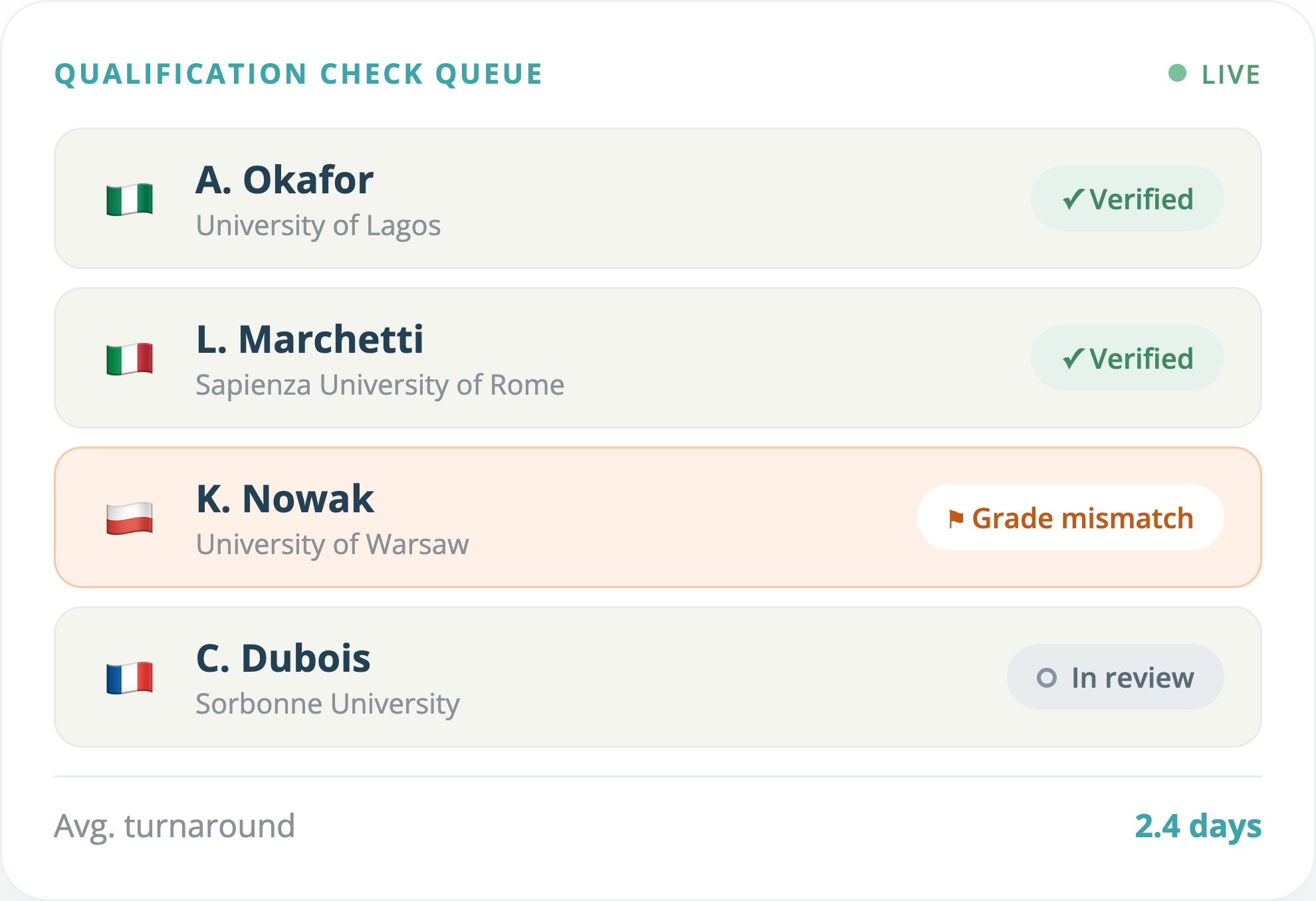
An audit trail for every decision. We confirm each credential directly with the issuing institution, catching the inconsistencies a document-only check can’t see.
challenge
PG peaks, January starts, and other deadlines can be overwhelming. Chasing institutions across 195+ countries manually is slow and hard to scale.
How we help
Your team reviews results, not paperwork. Applicants can initiate their own verification, and bulk upload handles whole cohorts. It works alongside your existing processes.
challenge
Strong candidates accept offers elsewhere while verification catches up. Every day of delay quietly costs you conversion.
How we help
Faster turnarounds. We clear straightforward cases fast. Most offer-stage checks return in around three days.
Step 1
As part of their offer, applicants are provided a unique link to upload their own credentials. The QC team support their application process.
Step 2
The uploaded credentials are then submitted to QC where our technology clears the straightforward cases within days. More difficult cases are then picked by our experts.
Step 3
You get a clear evidenced result, whether that is genuine or fraudulent, ready to action. The heavy lifting is removed and every decision is logged automatically for compliance.
Why teams trust the result
Qualification Check combines technology with human expertise. When our technology can confirm a credential, you get an instant result. When it can’t, our specialist in-house verification team, go to the source until there’s a definitive answer.
Instant routing across our network clears the straightforward cases in record time.
In-house specialists review every result the technology can’t confirm.
Anomalies are investigated to the source, we’ll work closely with your team so you get a clear verdict, not an unresolved flag.
The University of Law saw an increase in what they suspected to be fraudulent applications. 12% of those submitted verifications resulted in a ‘Not Verified’ outcome.
Kings College London realised that they needed extra support with verifying high-volume applications to protect its reputation from non-genuine applicants getting through to offer stage.
Having overseas degrees verified through a single online portal means that the turnaround time is now on average five days, compared to up to several weeks.
Free · 2 minutes · no sign-up to start
Five quick questions about how your team verifies qualifications today. You’ll get an instant risk rating and a tailored view of where the gaps are, drawn from what we see across thousands of institutions.
✓ Benchmarked against your peer institutions
✓ Pinpoints where to focus first
✓ Recommendations on best practices
Fraud-risk assessment
Answer five quick questions about how you verify qualifications today. We’ll rate your exposure and show you exactly where to focus to protect genuine applicants and your reputation.
Most admissions teams start with Global Verification which provides primary-source checks on applicant qualifications, submitted individually or in batches. Digital Identity Verification acts a deterrent to confirm the applicant is who they say they are, not just that the qualification is real. This product is used both by admissions but also enrolment teams.
Yes. Every verification produces a timestamped, evidenced record that’s exportable for audit. When you need to demonstrate due diligence on the qualifications behind a CAS, the evidence is already on file, supporting your sponsor duties and protecting your compliance rating.
No. Verification is a quality measure, not a volume cap. It doesn’t reduce the number of students you can recruit; it means the offers you make are built on accurate information. In practice that opens markets up rather than closing them down: institutions often pull back from higher-risk markets not because the demand isn’t genuine, but because they can’t reliably assess individual applications. With primary-source verification in place, you can recruit from those markets with confidence instead of retreating from them.
It also strengthens the metrics UKVI measures you on. Verified applications support your Basic Compliance Assessment (BCA): fewer visa refusals, because sponsorship decisions rest on confirmed information; stronger enrolment rates, because offers convert into genuine students; and better course completion, because the students you admit hold the qualifications the course assumes.
A verification costs a small, fixed amount per applicant. Set that against what it protects: tuition revenue from places awarded on accurate information, staff time spent chasing and authenticating documents manually, and your institution’s compliance position, including your sponsor duties and Basic Compliance Assessment (BCA) metrics. One withdrawn enrolment or compliance issue costs more than a full cycle of checks. To see figures based on your own intake, use our admissions risk assessment calculator.
Pricing is flexible and can be paid by the university or the applicant. Qualification Check has seen uptake increase when the university pays as it is removing a barrier for the applicant. For full pricing details see: https://qualificationcheck.com/pricing/
That’s the core of what we do. We maintain established relationships with universities, awarding bodies and ministries of education across 195+ countries, including the institutions that won’t respond to a cold email from an overseas admissions office.
Our in-house quality assessment team examine the document, contact the source, and report back plainly: genuine, discrepant, or fraudulent, with the evidence behind the verdict so your team can act with confidence.
It’s designed to speed it up. Straightforward credentials clear automatically, and bulk upload handles whole clearing cohorts at once, so verification runs alongside your decisions rather than holding them up. Most offer-stage checks return in around three days.
Documents show what an applicant holds; verification confirms it with the institution that issued it. Certificates and transcripts can be altered or purchased, and admissions teams aren’t resourced to authenticate documents from thousands of institutions worldwide. Primary-source verification removes that judgement call.
A database tells you what a qualification should look like. We confirm that this specific applicant was actually awarded it, by going back to the issuing institution. Verification answers whether the qualification was genuine. Universities have seen an increase in the number of fraudulent applications and this has only increased as technology has got more sophisticated.
We check the details the applicant supplies against the issuing institution’s own records: full name, date of birth, dates of attendance, institution, course title or award, qualification type, and classification or grade. Because the check goes back to the primary source, it confirms both that the qualification exists and that the details match.
It means the institution could not confirm the details as supplied. That can happen for several reasons: an error in the details the applicant provided, an outstanding fee the applicant owes the institution, or the applicant not holding the claimed qualification. A Not Verified result is a signal to look closer, not automatically a judgement on the applicant.
Request it through the platform (‘Request a new educational institution’) and our verifications team will add it and come back to you with an update. Coverage grows continuously this way.
Every verification has an Event History in the platform, updated as we receive information from the institution. You can filter by applicant name or reference number, use live chat, or contact your Account Manager.
Yes, add as many users as you need from the Account section of the platform. Each user receives their own invitation and login, and verification history stays with the account.